Unlike the federal exchange (HealthCare.gov) and many of the state-based exchanges which have experienced massive technical problems to some degree or another over the past two years (Oregon, Nevada and Hawaii have gone kaput; Massachusetts & Maryland had to be completely rebuilt; Vermonts is still iffy), the Kentucky ACA exchange website, aka "kynect" (lower-case intentional), has been chugging along smoothly since Day One on October 1, 2013. It's fully self-sufficient, well known and trusted by Kentuckians, and has been an amazingly successful venture in general.
Speaking in his first public comments since he was elected governor of Kentucky on Tuesday, Matt Bevin repeated his pledge to dismantle kynect, the state’s health insurance exchange that has been hailed as a national model.
“My intent is to have it wound down by the end of next year,” Bevin said of the online service people use to shop for health coverage or determine whether they are eligible for Medicaid under the Affordable Care Act.
One of the arguments Kentucky Governor-elect Matt Bevin has made in favor of killing off the wildly successful, smoothly-operating kynect state-based ACA exchange has been that doing so would "save Kentucky money". The idea is that by shifting everything over to the federal exchange at HealthCare.Gov, the state of Kentucky would save the cost of operating their own exchange.
In one sense, this is true; kynect is currently supported by a flat 1% charge for all premiums on all individual policies sold in Kentucky, both "inside and outside of the marketplace." In other words. whether you enroll in a individual policy either via Kynect or directly through the insurance carrier, they're tacking on a 1% surcharge to your premiums to pay for the exchang to operate. So, yes, dropping kynect would also stop that 1% fee from being charged.
Ultimately, the blame lies with the voters for failing to care about their own interests, but I do want to say one thing about Democratic candidate Jack Conway's campaign.
I've mentioned tomorrow's Kentucky gubernatorial election, and the fact that Republican candidate Matt Bevin is not just a staunch opponent of the ACA (not exactly a shocker) but that he's repeatedly stated that if elected, he'd repeal the state's implementation of Medicaid expansion, which is currently providing healthcare coverage for about 400,000 people (around 350K enrolled in 2014, and another 50K or so this year).
However, I was a bit shocked this morning when I realized that I've only mentioned the KY race in passing via my "Short Cuts" link roundups.
With the election just one day away and my plate filled with other OE3-related stuff, I don't really have time to do a full write-up. Fortunately, John Oliver of Last Week Tonight has done an excellent job of explaining the whole situation (there's actually three state elections tomorrow where Medicaid expansion is theoretically an issue, but Kentucky is the only one where it's at risk of being taken away). Watch the whole thing:
The short version is that there were 3 funding programs put in place under the Affordable Care Act designed specifically to help smooth the waters and keep insurance carriers afloat for the first few years until they got past the bumpy transition period. One of these was called the "Risk Corridor" program. Basically, the carriers who lose their shirts the first 3 years were supposed to have at least a portion of their losses covered to tide them over; call it "training wheels" for the insurance industry. The funding was supposed to come partially from the other insurance companies which did better than expected...but any shortfall was supposed to be covered by the federal government, with the caveat that any surplus paid to the government stayed there as a type of profit.
A couple of days ago I noted that Covered California is adding a very good feature this year: They're opening up 2016 enrollment nearly 3 weeks early...for those who are already currently enrolled. Starting this monday, Oct. 12, current enrollees will be able to renew or switch to a different CoveredCA plan, 19 days ahead of he official Nov. 1st Open Enrollment launch.
I clicked through and saw this listed under the Frequently Asked Questions:
1. How do I enroll in kynect?
Simply visit kynect.ky.gov or talk to your insurance agent. If your insurance plan is up for renewal, you may be eligible to enroll through kynect today. You can also call Customer Service at 1-855-4kynect (459-6328).
I was kind of hoping that this morning's Gallup uninsured rate news would include a monthly update for July; instead, it only runs through the end of June, the same quarterly survey results that they released a month ago. Then again, things probably didn't change much in July.
Instead, this time they've broken the numbers out by state:
WASHINGTON, D.C. -- Arkansas and Kentucky continue to have the sharpest reductions in their uninsured rates since the healthcare law took effect at the beginning of 2014. Oregon, Rhode Island and Washington join them as states that have at least a 10-percentage-point reduction in uninsured rates.
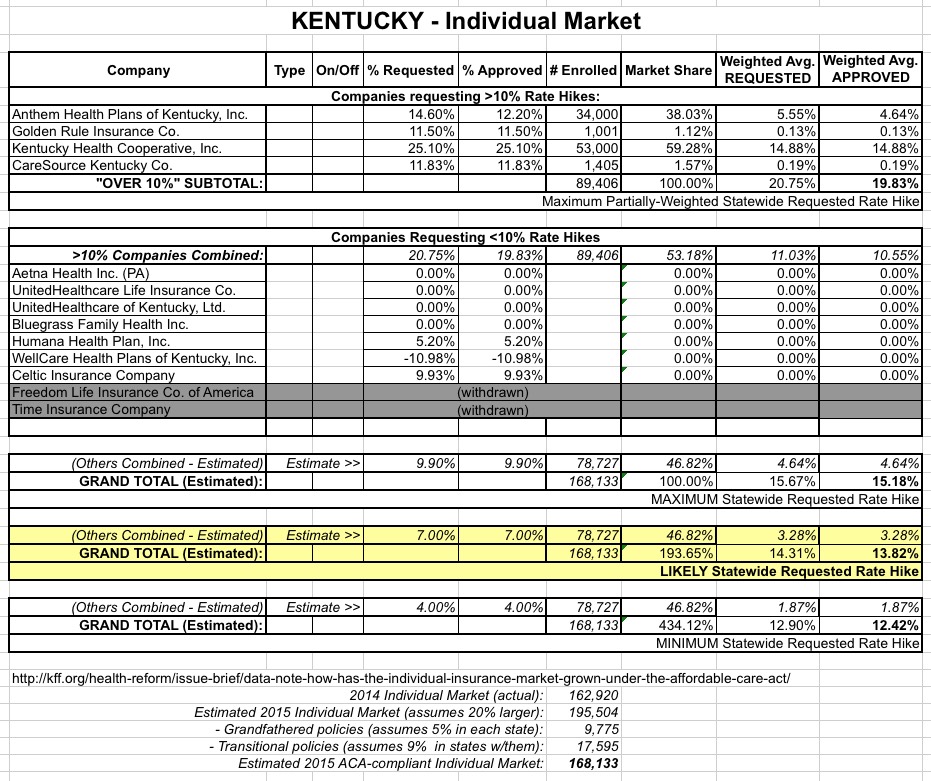
IMPORTANT:See this detailed explanation of how I've come up with the following estimated maximum approved weighted average rate increases for Kentucky.
Fortunately, as I explain in the first link above, I've still been able to piece together rough estimates of the maximum possible and most likely approved average rate increase for the Kentucky individual market:
This AP article provides snippets about a handful of states; it'd be nice if they just released the actual report so we could see the hard expansion numbers (as opposed to the total increase numbers, which are still obviously useful but don't distinguish between traditional Medicaid and ACA expansion enrollees):
In Kentucky, for example, enrollments during the 2014 fiscal year were more than double the number projected, with almost 311,000 newly eligible residents signing up. That's greater than what was initially predicted through 2021.
...At least 14 states have seen new enrollments exceed their original projections, causing at least seven to increase their cost estimates for 2017, according to an Associated Press analysis of state budget projections, Medicaid enrollments and cost details in the expansion states. A few states said they could not provide original projections.
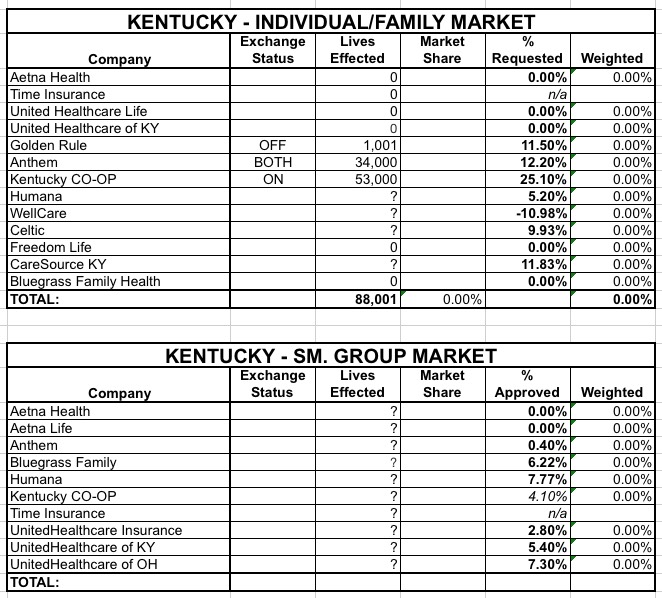
Last week Oregon became the first state to actually approve their 2016 individual/family and small group market policy rate changes. Yesterday, Kentucky appears to have become the second:
Unfortunately, as you can see, while the average rate request for each company is listed, it isn't easy to find the actual enrollment/market share data for most of them, making it impossible to get a weighted average. In addition, there's an awful lot of "n/a / 0%" entries for some pretty big companies. Usually this means that they're new to the market, but I'm not sure that's the case here.
Anyway, assuming that I have the partial data above accurate, it looks like Kentucky's individual market changes will range from an 11% decrease (for WellCare Health Plans of Kentucky, Inc.) to a wince-inducing 25% increase (for the Kentucky Health CO-OP). I don't know how many are enrolled in WellCare right now, but the CO-OP has 53,000 customers, so expect some shuffling around...except, again, I have no idea what that's a 25.1% increase from.